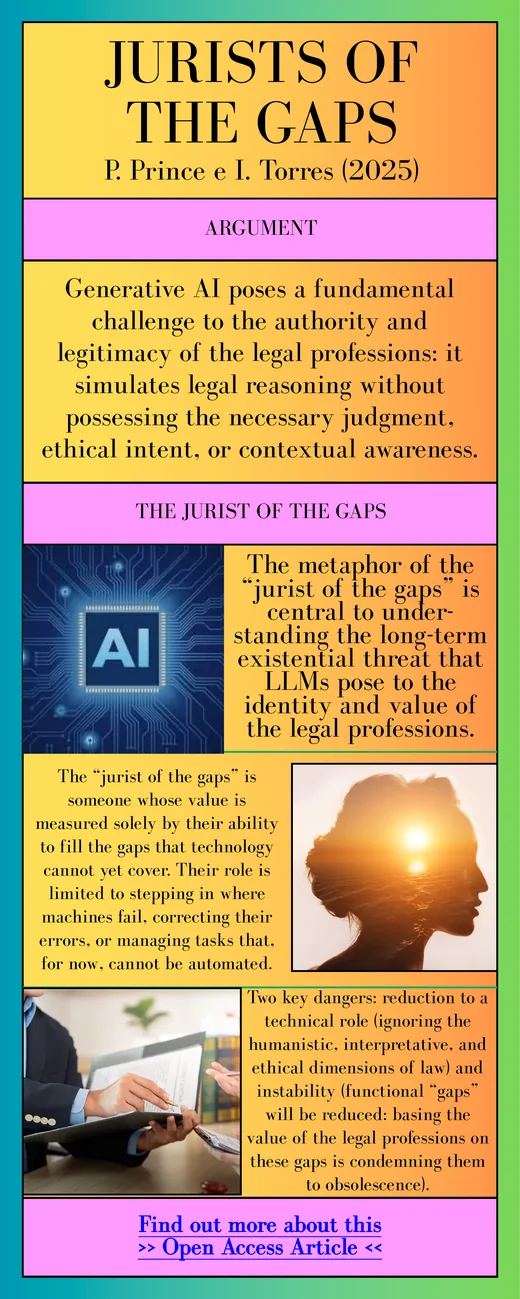
Let’s be clear: most scientific papers are destined to be skimmed, summarized by AI, or read no further than the abstract. That is precisely why Dr. Ilsse C. Torres Ortega turned the article into an infographic. The argument deserves to reach people, even if the PDF stays closed.
The article is titled “Jurists of the Gaps: Large Language Models and the Quiet Erosion of Legal Authority”, published open access in the Masaryk University Journal of Law and Technology, 2025. Its thesis, stated plainly: large language models erode legal authority silently, in the gaps that no one measures. The “jurists of the gaps” are not lawyers who improvise; they are the AI systems we allow to occupy the spaces where no one expects them to fail.
Luddite is not an insult
The #ailuddite movement, of which this article forms part, is routinely misread. It is not an anti-technology position. It is a demand for evidence before adoption; an explicit rejection of the techno-enthusiasm that sells solutions before understanding problems, and that produces concrete risks in legal contexts: professional liability, confidentiality, quality of reasoning.
Reclaiming the word “Luddite” as an analytical category rather than an insult is itself a methodological act. It states: before implementing, I need to understand what this system does and what it cannot do. In LegalTech, that basic question is rarely asked.
Why this article functions as an argument
A peer-reviewed article, published open access with an explicit methodology, is more than academic knowledge; it is an argument. In a board meeting, in a technology due diligence process, facing a client who wants to deploy AI in contract review, the difference between a personal opinion and a documented position is the difference between being heard and being dismissed.
Researcher Dagmar Monett has been working along the same line of critical rigor for years. Her reading of the real limits of AI systems is particularly sharp and worth following if the topic interests you.
The article is available open access here. We will likely organize a webinar to present the thesis. If you are interested, stay tuned.